Are Interior Designers Being Misled by AI Rendering Tools?
Are Interior Designers Being Misled by AI Rendering Tools?
Are Interior Designers Being Misled by AI Rendering Tools?
27th April 2026 ~ James Lyons
27th April 2026 ~ James Lyons
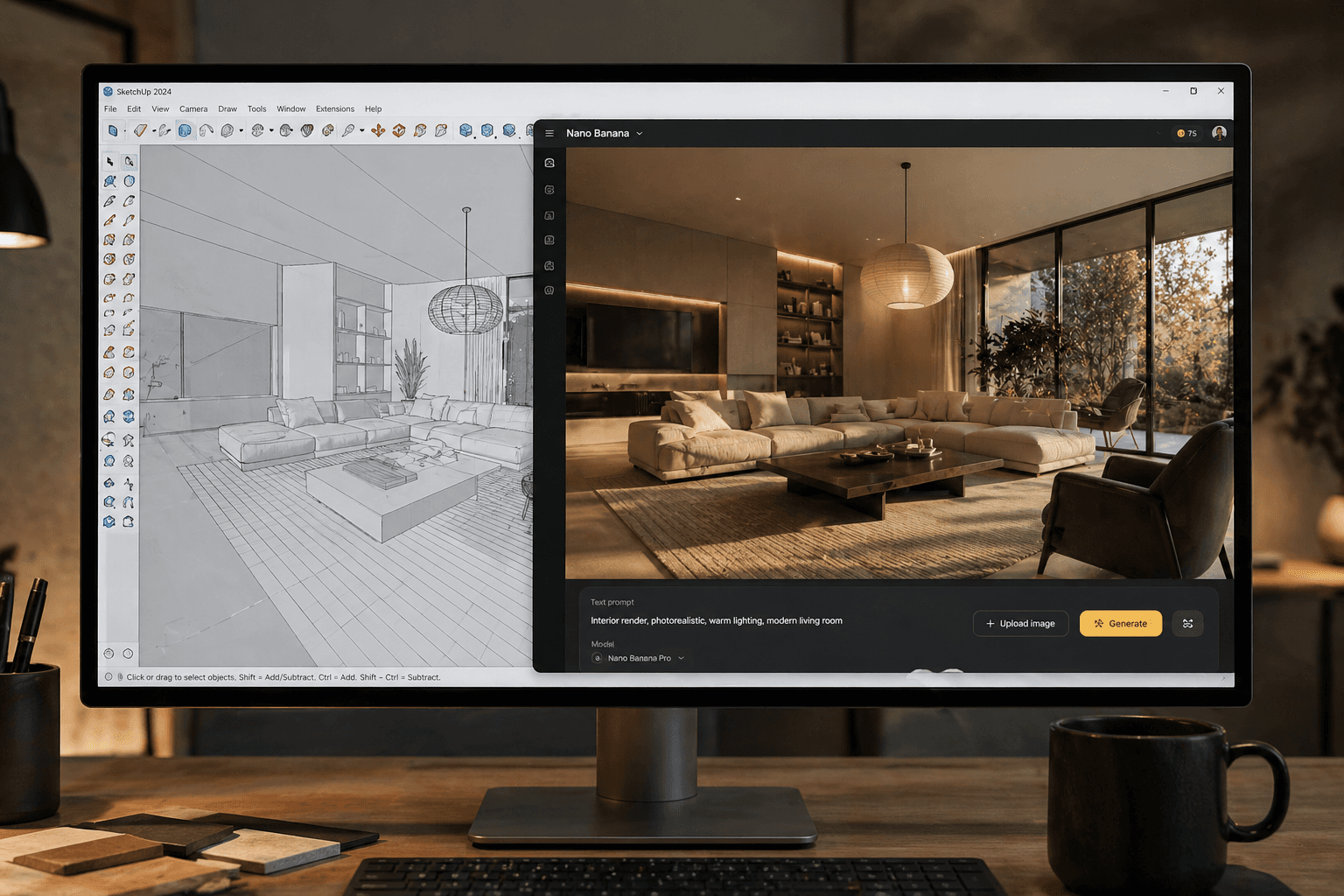
Over the past year, AI has rapidly positioned itself at the centre of conversations around architectural visualisation. For interior designers in particular, the proposition is compelling. The idea that a SketchUp model can be transformed into a high-end, photorealistic render within seconds, all for a relatively small monthly subscription, feels like a natural evolution of the design process.
At first glance, it appears to remove friction entirely. There is no need to outsource, no long wait times, and no requirement for specialist rendering knowledge. The promise is simple: upload, generate, and present.
However, as more designers begin to integrate these tools into real projects, a more nuanced reality is starting to emerge.
What is often left out of the marketing narrative is the level of understanding required to consistently achieve the kind of results being advertised. While AI rendering platforms showcase polished, high-end imagery, they rarely explain the process behind those outcomes. Prompting, in particular, is frequently positioned as intuitive, yet in practice it behaves more like a learned skill. The structure of a prompt, the clarity of material direction, and the control of lighting and composition all play a significant role in the final image.
Without that understanding, the experience can quickly shift from efficiency to iteration. Designers may find themselves generating multiple versions of the same scene, gradually refining the result through trial and error rather than intention. In a system built around monthly credits, this process can become both time-consuming and unexpectedly expensive.
There is also a more fundamental question around authorship and control. Even when working from a clean 3D model, AI does not simply translate geometry into a finished image. It interprets. Materials are inferred, lighting is adjusted, and in some cases, elements of the design itself can shift subtly. While these changes are often visually appealing, they are not always accurate representations of the original intent.
For interior designers presenting to clients or working within planning constraints, this distinction matters. A visual is not just an image; it is a communication tool. When that communication becomes partially driven by an AI’s interpretation, inconsistencies can begin to surface, leading to further revisions and, in some cases, a disconnect between the design and its visualisation.
Consistency is another area where the gap between expectation and reality becomes clear. Producing a single compelling image is one thing, but delivering a full set of visuals across multiple angles, all aligned in tone, materiality and lighting, is considerably more complex. Without a structured workflow, maintaining that level of coherence using AI alone can be difficult.
None of this is to suggest that AI rendering tools are ineffective. On the contrary, they represent a significant step forward in how architectural visualisation can be approached. When used with the right level of understanding, they can accelerate early-stage concept work, enhance atmosphere, and open up new creative possibilities.
The challenge lies in how they are positioned.
There is a growing perception that these tools can replace traditional CGI processes entirely. In reality, what is becoming increasingly clear is that the most effective results come from a hybrid approach. Experience in composition, lighting, and material realism still plays a crucial role, even when AI is part of the workflow.
Over the past year, this is something I’ve been exploring through my own work at Pixelspaces. Rather than treating AI as a shortcut, it has been integrated into a broader architectural visualisation process, sitting alongside traditional 3D modelling and rendering techniques. The result is not just speed, but a more controlled and consistent output that remains aligned with the original design intent.
This approach also shifts the role of the CGI artist. Instead of being replaced, it becomes more refined. The focus moves toward directing the image, understanding where AI can enhance a scene and where it needs to be constrained. It is less about generating visuals instantly, and more about knowing how to guide the process effectively.
For interior designers navigating this space, the key question is not whether to use AI, but how to use it well. The tools themselves will continue to evolve, and their capabilities will only improve. What remains constant is the need for clarity, control, and an understanding of the visual language being created.
There is also a broader conversation to be had around expectations. The speed of AI can create the impression that high-end visualisation should now be instant and inexpensive by default. But as many are beginning to discover, achieving a truly polished and accurate result still requires time, whether that time is spent modelling, prompting, or refining.
In that sense, the role of architectural visualisation has not been simplified, but redistributed.
As the industry continues to adapt, it will be interesting to see how interior designers balance these tools within their workflow. Whether they choose to develop that expertise internally or collaborate with specialists who already operate within this hybrid space, the underlying goal remains the same: to produce visuals that not only look impressive, but communicate design intent clearly and consistently.
For now, the conversation is still open. And perhaps that is the most important point of all.
Over the past year, AI has rapidly positioned itself at the centre of conversations around architectural visualisation. For interior designers in particular, the proposition is compelling. The idea that a SketchUp model can be transformed into a high-end, photorealistic render within seconds, all for a relatively small monthly subscription, feels like a natural evolution of the design process.
At first glance, it appears to remove friction entirely. There is no need to outsource, no long wait times, and no requirement for specialist rendering knowledge. The promise is simple: upload, generate, and present.
However, as more designers begin to integrate these tools into real projects, a more nuanced reality is starting to emerge.
What is often left out of the marketing narrative is the level of understanding required to consistently achieve the kind of results being advertised. While AI rendering platforms showcase polished, high-end imagery, they rarely explain the process behind those outcomes. Prompting, in particular, is frequently positioned as intuitive, yet in practice it behaves more like a learned skill. The structure of a prompt, the clarity of material direction, and the control of lighting and composition all play a significant role in the final image.
Without that understanding, the experience can quickly shift from efficiency to iteration. Designers may find themselves generating multiple versions of the same scene, gradually refining the result through trial and error rather than intention. In a system built around monthly credits, this process can become both time-consuming and unexpectedly expensive.
There is also a more fundamental question around authorship and control. Even when working from a clean 3D model, AI does not simply translate geometry into a finished image. It interprets. Materials are inferred, lighting is adjusted, and in some cases, elements of the design itself can shift subtly. While these changes are often visually appealing, they are not always accurate representations of the original intent.
For interior designers presenting to clients or working within planning constraints, this distinction matters. A visual is not just an image; it is a communication tool. When that communication becomes partially driven by an AI’s interpretation, inconsistencies can begin to surface, leading to further revisions and, in some cases, a disconnect between the design and its visualisation.
Consistency is another area where the gap between expectation and reality becomes clear. Producing a single compelling image is one thing, but delivering a full set of visuals across multiple angles, all aligned in tone, materiality and lighting, is considerably more complex. Without a structured workflow, maintaining that level of coherence using AI alone can be difficult.
None of this is to suggest that AI rendering tools are ineffective. On the contrary, they represent a significant step forward in how architectural visualisation can be approached. When used with the right level of understanding, they can accelerate early-stage concept work, enhance atmosphere, and open up new creative possibilities.
The challenge lies in how they are positioned.
There is a growing perception that these tools can replace traditional CGI processes entirely. In reality, what is becoming increasingly clear is that the most effective results come from a hybrid approach. Experience in composition, lighting, and material realism still plays a crucial role, even when AI is part of the workflow.
Over the past year, this is something I’ve been exploring through my own work at Pixelspaces. Rather than treating AI as a shortcut, it has been integrated into a broader architectural visualisation process, sitting alongside traditional 3D modelling and rendering techniques. The result is not just speed, but a more controlled and consistent output that remains aligned with the original design intent.
This approach also shifts the role of the CGI artist. Instead of being replaced, it becomes more refined. The focus moves toward directing the image, understanding where AI can enhance a scene and where it needs to be constrained. It is less about generating visuals instantly, and more about knowing how to guide the process effectively.
For interior designers navigating this space, the key question is not whether to use AI, but how to use it well. The tools themselves will continue to evolve, and their capabilities will only improve. What remains constant is the need for clarity, control, and an understanding of the visual language being created.
There is also a broader conversation to be had around expectations. The speed of AI can create the impression that high-end visualisation should now be instant and inexpensive by default. But as many are beginning to discover, achieving a truly polished and accurate result still requires time, whether that time is spent modelling, prompting, or refining.
In that sense, the role of architectural visualisation has not been simplified, but redistributed.
As the industry continues to adapt, it will be interesting to see how interior designers balance these tools within their workflow. Whether they choose to develop that expertise internally or collaborate with specialists who already operate within this hybrid space, the underlying goal remains the same: to produce visuals that not only look impressive, but communicate design intent clearly and consistently.
For now, the conversation is still open. And perhaps that is the most important point of all.