GPT-6 Astra: Could AI Finally Change the Way Architects and 3D Designers Work Together?
GPT-6 Astra: Could AI Finally Change the Way Architects and 3D Designers Work Together?
GPT-6 Astra: Could AI Finally Change the Way Architects and 3D Designers Work Together?
1st November 2026 ~ James Lyons
1st November 2026 ~ James Lyons

There has been a lot of talk over the last few years about how artificial intelligence is going to change architectural visualisation, 3D modelling and design.
We’ve already seen AI transform image generation, concept development and architectural rendering. But something about the latest developments feels different.
OpenAI’s new GPT-6 Astra is beginning to demonstrate the ability to actually operate software, rather than simply telling us how to use it. In demonstrations, Astra has been shown working inside applications such as Blender and Unreal Engine, carrying out multi-step creative tasks and building 3D scenes.
And for anyone working in architecture, interior design, CGI and 3D visualisation, that could be a very significant development.
From generating images to actually doing the work
One of the most interesting things about Astra isn’t simply that it can create something that looks like a 3D model.
The bigger development is that AI can increasingly interact with the software itself.
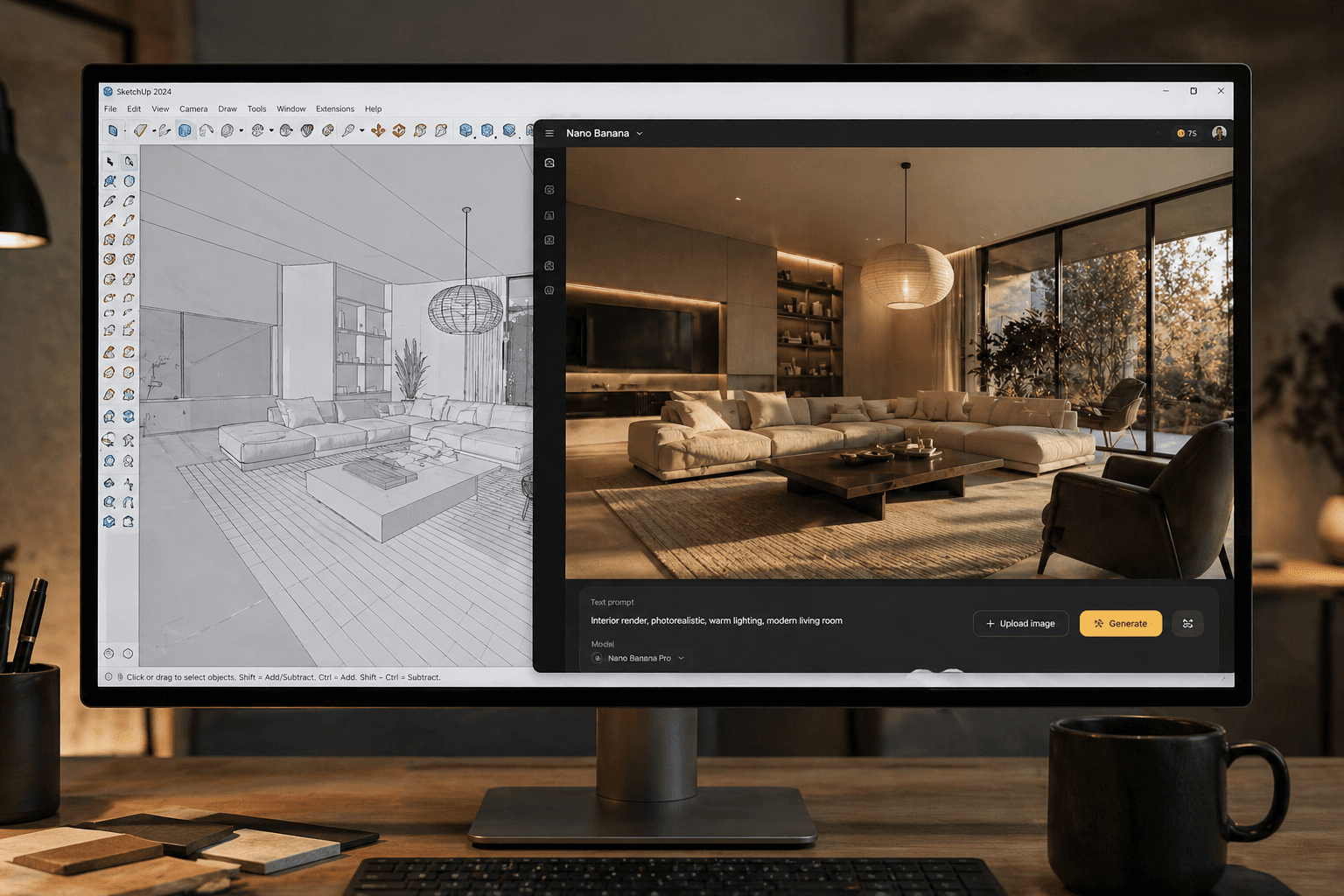
Instead of asking an AI to generate an image of a building, imagine being able to describe what you want and have an AI agent open your 3D software, create geometry, apply materials, set up cameras, make changes and iterate through the design.
That is a very different proposition from traditional AI image generation.
It starts to blur the line between AI as a design tool and AI as a member of the design workflow.
And that is where I think things could get particularly interesting for architectural visualisation.
What could this mean for architects and designers?
For years, one of the biggest challenges in architectural CGI hasn’t necessarily been the final render.
It is everything that happens before it.
An architect has an idea. A designer develops it. Drawings are produced. Models are exchanged. Questions are asked. Changes are made. Information is interpreted. A 3D artist takes that information and turns it into something visual.
There can be a lot of communication and iteration between the original idea and the final visualisation.
My career has increasingly focused on trying to make that process as streamlined as possible.
The goal isn’t simply to produce a better render. It is to reduce the distance between “this is what we’re thinking” and “this is what it actually looks like.”
That is why Astra is so exciting to me.
If an AI agent can eventually sit inside the 3D workflow and help turn instructions, drawings and design decisions into editable 3D scenes, we could potentially remove some of the friction that currently exists between architects, designers and visualisation artists.
Imagine shortening the gap between an idea and a 3D model
Imagine an architect saying:
“Take this plan, create the building massing, add the proposed facade treatment and set up a camera from this position.”
Instead of that becoming a task that needs to be manually modelled from scratch, the AI could potentially carry out much of the initial process directly inside the 3D software.
Then the designer could say:
“Make the windows taller.”
“Push this section of the facade back.”
“Change the material to stone.”
“Try a version with a softer roof profile.”
And the model could continue to evolve.
We’re not there yet in terms of making that workflow completely reliable, and Astra is still in its rollout phase. But the direction of travel is incredibly interesting. OpenAI describes Astra as having significantly improved computer-use capabilities, allowing it to carry out complex multi-step workflows across software environments.
This isn’t about replacing the designer
For me, this is an important distinction.
I’m not particularly interested in the idea of AI simply replacing the people involved in architectural design or 3D visualisation.
The exciting possibility is almost the opposite.
If the repetitive and time-consuming parts of the workflow become faster, it gives architects, designers and CGI artists more time to focus on the things that actually require judgement, creativity and experience.
The architect still decides what the building should be.
The designer still decides what it should feel like.
The visualisation artist still has an important role in understanding how to communicate that idea visually.
But the distance between those decisions and seeing the result could become dramatically shorter.
The future of architectural visualisation could be much more collaborative
This is the part that interests me most.
I’ve always believed that the best architectural visualisation comes from collaboration.
The CGI artist shouldn’t just be the person who receives a finished design at the end of the process and turns it into an image.
The more useful role is being involved earlier, helping architects and designers explore ideas, test options and understand how something will actually look.
AI could potentially make that collaboration even more immediate.
Rather than waiting for a model to be built, a camera to be positioned and a render to be produced before making a decision, we could move towards a workflow where ideas are visualised almost as quickly as they are discussed.
That could mean faster design development, quicker client feedback, more iterations and ultimately better communication between everyone involved in a project.
We’re still very early
It’s important not to get carried away.
Astra is impressive, but this is still an emerging technology. The demonstrations are not the same thing as having a completely reliable AI 3D artist sitting beside you every day.
There will be mistakes.
There will be tasks it can’t understand.
There will be situations where an experienced 3D artist can achieve a better result much faster.
And architectural projects have very specific requirements around accuracy, scale, materials, geometry and design intent that can’t simply be ignored.
But that’s exactly why I’m excited to start testing it.
The question isn’t whether AI can produce a pretty 3D image.
We’ve already answered that.
The much more interesting question is whether AI can become part of the actual 3D modelling and architectural visualisation workflow.
If it can, the implications could be much bigger.
The next step for AI in 3D
We’ve gone from AI generating images, to AI helping us edit images, to AI helping us generate 3D assets.
Now we’re starting to see AI actually interact with the software in which those assets are created.
That feels like a significant shift.
For architects, interior designers, developers and 3D artists, it could eventually mean a much more fluid relationship between an idea and its visual representation.
And that is something I’m particularly interested in exploring at Pixelspaces.
I’ve spent a large part of my career trying to make the process between architect → designer → 3D artist → client as efficient and collaborative as possible.
If AI can help remove some of the friction from that chain, while still keeping the creative decisions firmly in human hands, I think it could become one of the most useful developments we’ve seen in architectural visualisation for a long time.
I’m still waiting to get properly hands-on with Astra.
But I am very excited to see what happens when we start putting it through real architectural and 3D design workflows.
Because if the technology develops in the direction it currently appears to be heading, the biggest change may not be that AI can create 3D models.
It may be that getting an idea into 3D becomes almost instantaneous.